Stories that Inspire.
Victories to Celebrate.
RMA VC is breaking bread, building futures
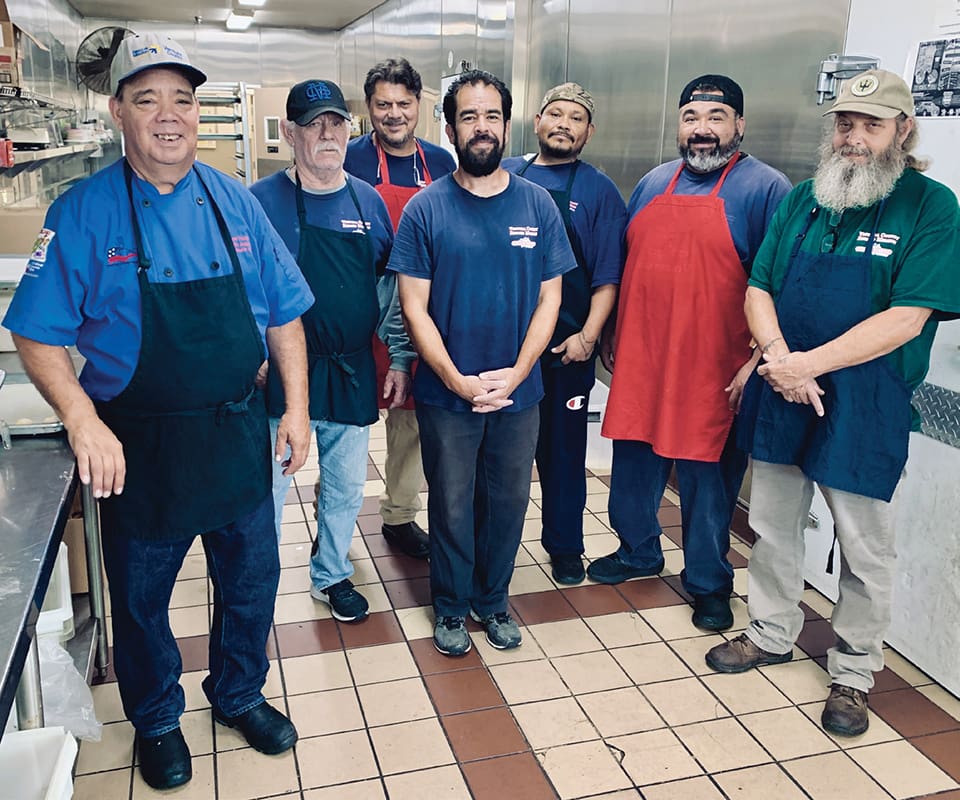
Chef Richard (far left) feels “most satisfied” when he’s sharing his passion for food with the Culinary Arts residents.
The holidays are upon us and for most of us it is a time of gifts, gatherings, and sharing our good fortune over generous and sometimes extravagant meals. Many of us take all of this for granted, not giving much thought, if any, to what it means to always have enough to eat. Never thinking deeply about our food and about how primary it is— not only for our continued existence, but how it is woven into so many areas of our lives. If asked, of course, we would agree that we all need to eat, that food is as essential as air and water, and is a basic requirement for life. Beyond that, though, food and the sharing of meals have a psychological, social, economic, and spiritual context in our lives.
In the decades that RMA VC has been open, we have learned that the offering and sharing of meals, as well as being nourishing to our physical bodies, can bring people out of homelessness and into our shelters and programs, can foster relationships and fellowship among our clients and guests, can lead to fulfilling career opportunities through our culinary arts training, and can foster an openness to spiritual truths.
In other words, food, and in particular the preparing and sharing of meals, is physically sustaining, socially enhancing, economically supportive, and imbued with spiritual meaning.
The first steps off the streets and out of homelessness and addiction often begin with a hot meal at the Mission. It is difficult to think of much else when you are constantly hungry, so having enough to eat on a regular basis can sometimes be the catalyst for real change. Program Assistant Tommy Davis helps with giving out meals and often develops relationships with those we serve.
“I am always encouraging men to come into the shelter or the program,” he said. “Sometimes it can take months, if it happens at all, but I keep trying. ‘Hey, when are you coming in?’ is my persistent question.”
Tommy pointed out that the Mission just had a man come into the shelter after months of hesitation, and he credits that primarily to our meals. “The food is what kept him coming back, and that gave me a chance to coax him in off the street.”
Our outreach efforts, bringing meals to those in need where they are, is also a vital part of our mission. By partnering with the County of Ventura at One Stop locations, handing out sack lunches at Community Action, or taking meals to remote locations, we are providing an essential link in the chain that can lead from homelessness and addiction, to refuge, recovery, and restoration.
Ministry Resident Javier assists with outreach each week and has a first-hand perspective of the impact of our efforts on those we serve.
“There are many people in need who can’t or don’t want to come to us for services. They might have found a safe place to stay and are unwilling to leave their belongings unattended. Or maybe they feel unsafe around the crowds that join us for meals,” said Javier.
“By going to where they are, we are both providing food and, hopefully, developing relationships and trust that might lead to shelter or a program.”
And by partnering with other organizations, we are part of a network of care, offering food, clothing, medical care, case management, and recovery and shelter options to the homeless and struggling in our community.
Weeknights are the heart of our efforts to feed the hungry, as we invite our neighbors in need to come inside, sit down, and be served a hot meal prepared by our culinary team and served by our volunteers. For many, this is the only opportunity to dine inside and to feel that someone cares enough to not only feed them, but to do so in a way that shows they have value.
“When people think of rescue missions and meals, they might have the ‘soup kitchen’ model in mind,” explained Mission Support Supervisor Chris Burgess. “They picture a long line of people waiting for something to be spooned into a bowl. Instead, our guests sit down and are brought a plate of food. This might not seem like much to most of us who can afford to dine out, but to those we serve, it matters. How you eat can affect your sense of self-worth and we strive to offer some dignity along with our hot meals.”

RMA VC, hundreds of meals are prepared and served to our community each day — a meaningful act of service that often opens the door for our guests to join the program.
Preparing and serving hundreds of meals a day (totaling over 238,000 meals last year) is only possible through the efforts of our Chef and program graduate, Richard Varble and his Culinary Arts team of Life Recovery Program men. Chef Richard has been with us for over 18 years and has more than 44 years of culinary experience (including being an American Culinary Federation Chef). When asked about the best part of his job, he lists several benefits:
“First of all, I am grateful for what the Rescue Mission has done for me, so being able to give back and have a career here has been amazing. I enjoy being able to help feed so many of our less fortunate neighbors and being able to do that while being creative with our donations keeps the job interesting and challenging. But the thing I like best, is teaching the men in our program and the women at the Lighthouse, preparing them for careers in the food service industry.”
Chef Richard estimates that he has helped around 50 men in our program find work and in some cases careers in restaurants, hotels, resorts, on oil rigs, and more through the training they receive in the Culinary Arts track of our vocational training. “That’s got to be the most satisfying thing to me,” he said. “I get to teach what I love and possibly pass my passion for cooking onto others.”
One of those benefiting from Chef Richard and the Culinary Arts Program is Gary McFarlane. Gary first came to us in 2012 and up to that point had no kitchen experience.

The Culinary Arts program has led to 50 men finding work in the food industry. Many have turned their experience into a career!
“I was put in the kitchen for my vocational assignment about a month into the program. Short of doing a little cooking, I knew zero about running a kitchen and preparing so many meals on a daily basis,” he recalled.
It didn’t take Gary long before he began developing a genuine interest and curiosity about what he was doing. “The more I learned, the more I wanted to learn. I was made kitchen lead a few months in and I got closer to Chef Richard and tried to absorb all he had to teach me.”
By the time Gary was nearing completion of the recovery program he knew what he wanted to do. “I went from knowing nothing about working in a kitchen, to having a solid foundation of cooking skills, menu prep, food ordering, and even teaching some of the newer men in just a few months. I’m not saying I was a world class chef when I left, but I was certainly on my way to a fulfilling career.”
Gary has gone on to work as a line cook at Famous Daves, a Sous Chef at an Ojai Christian camp, and then spent 10 years as the Executive Chef at Passages in Malibu. “Next to my relationship with Jesus, my time in the Culinary Arts program at the Mission has had the most impact on my life,” said Gary.
Out of homelessness to our shelters, into our recovery programs and beyond to jobs and stable housing, the meals we plan, prepare, and serve help sustain life, foster community, and support promising futures. Our Director Michael Darden sums up the impact of the meals we provide in this way:
“Every meal we serve offers the chance of a new beginning. Over the years I have seen countless people come to the Mission for a meal because they were hungry and hopeless and that one dinner changed the trajectory of their whole life. They came for the meal, stayed for the recovery and left with a new career.”
Be Inspired
Be Transformed
Stay connected with the good work the Mission is doing, and learn more about the people we help.